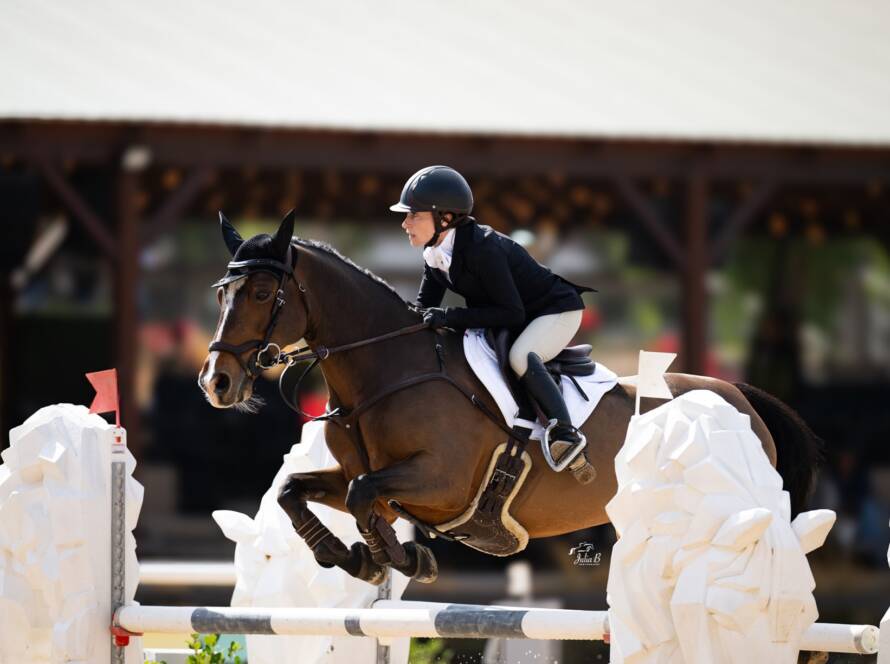
Peter Gray’s title as Ground Jury President for the Eventing Championships at Galway Downs is lofty on its own. But it reflects only a sliver of the Canadian-by-way-of-Bermuda equestrian’s contributions to our sport.
A two-time eventing Olympian, Peter coaches top riders, gives clinics for all levels, leads or contributes to educational programs, and is an active dressage rider and competitor.
Fresh From Aachen

He comes to Galway Downs this fall fresh from the FEI Eventing World Championships in Aachen, Germany, where he was a Ground Jury member. There’s nothing quite like it, Peter shares. “It was only a few weeks ago, but it feels like a dream that I was ever there. It was so surreal and so incredible.”
The stand-out memory is the crowd’s obvious knowledge of and appreciation for the sport. “The coliseums were packed every day and the crowd is so enthusiastic and educated. They cheer and wave flags in a thunderous way. It’s overwhelming! We’re not used to those crowds in North America and it was really exciting.”
As a sport insider and advocate, Peter came away pleased with how all aspects of the Championships presented a “very good image to the world.” The general public’s perception of how horses are treated is increasingly key to equestrian sport’s existence. That message was embraced at all levels of the Championships — from the organizers and officials to the riders. “There were no dramas and I think it was all fantastically successful.”
Course designer Giuseppe della Chiesa’s cross-country course reflected one example of that mission: rather than the standard “black flag” option of a single fence within an especially difficult combination, the track offered full A-B-C-D combinations as alternate routes. The course had 42 jumping efforts and 74 fences total. “So, no matter what level of experience the pair had, there was a way to get around the course and show that nice image on television,” Peter notes.
Happy Horse = Happy Judge

Bringing a lifetime of horsemanship and training to his judging perspective, Peter rewards free movement and signs that the horse is relaxed — a “happy horse equals happy judge.” He’s pleased to see the idea gaining ground in European dressage, where horses moving freely and without signs of controlled tension earned the highest marks at this year’s FEI Dressage World Championship.
When things evolve at the top of the sport, that needle moves through all levels — maybe not immediately, but eventually, Peter hopes. “I think we need to pay attention on this side of the ocean to what modern trends are getting the best scores.”
The same emphasis shapes his coaching: a classical dressage foundation evident in a soft feel in the reins, freedom in the gaits, and a lack of “micromanagement” from the rider.
Patience is another key Peter principle. As he told Sally Spickard on the March 2026 GoEventing podcast, “It’s better to upgrade to the next level a year too late than a day too early.” Rushing up the levels, he says, means missing pieces of the training base — and that eventually causes a problem.
In dressage, the foundation for cross-country and show jumping, his approach is simple: “It’s all really about forward and back transitions in all three gaits. [British dressage gold medalist] Carl Hester says do 1,000 of them every day, and I support that!”
Education is Everything
Peter holds the highest FEI judging credential, a Level 4 (formerly called “5*” or “O”), required for officiating at the Olympics and World Championships. He’s unusual among his contemporaries in that he continues to judge at all levels. “I love the grass roots,” he confirms. “In fact, the day before I flew to Aachen, I did a local event here in the Toronto area — Training level and below — and the kids were thrilled to get a good judge. I was happy to encourage the younger riders.”
The MARS Bromont Rising program is close to his heart. As program director, he helps select recipients of its scholarships for young American and Canadian eventers and related educational opportunities — including one in the planning stages for Galway Downs’ Spring International Horse Trials in 2027. “We want to have people doing presentations on mental health, stable management, and have really good clinicians in for it,” he reveals. “I’m really excited about it and I think it’s going to be a big deal.”
Peter walks his talk on education. He notes that social media can help or hurt when it comes to spreading training advice, so he filters for content from top horsemen he admires — Carl Hester and Swedish show jumper Henrik von Eckermann among them. Masterclasses on YouTube, analyzing international dressage judging, and the continuing education needed to maintain his FEI license all feed his ongoing effort to keep learning as a judge, sport advocate, and horseman.
Galway Downs Connection
Peter’s first assignment for Galway Downs, eight years ago, was also his first visit to California. He recalls being excited “because California has this sort of romantic appeal to it. The culture out there is very healthy and I like it a lot.” In the western U.S. and Canada, he’s noticed that eventing is often a family affair: “People have traveled so far, and very often the non-horsey city dad or brother comes in and they camp. It creates a really nice culture. There’s a really good vibe out there and I love the atmosphere.”
Peter praises Galway Downs organizer Robert Kellerhouse. “We should roll out the red carpet for Robert,” he asserts. “The sport would not be what it is without him.” Through the Bromont Rising program, Peter has seen firsthand Robert’s genuine enthusiasm for anything that helps riders and horses in his region. “You should all be very proud and grateful to have someone like him at the helm.”
Bringing Bermuda to the Olympics
Peter was born and raised in Bermuda, where his ancestors landed by accident in the early 1600s — en route from Great Britain to colonize New England, they instead hit the reefs and were shipwrecked. “They rebuilt the ship and some went on to Virginia and some stayed and settled in Bermuda,” Peter explains. His ancestors stayed.
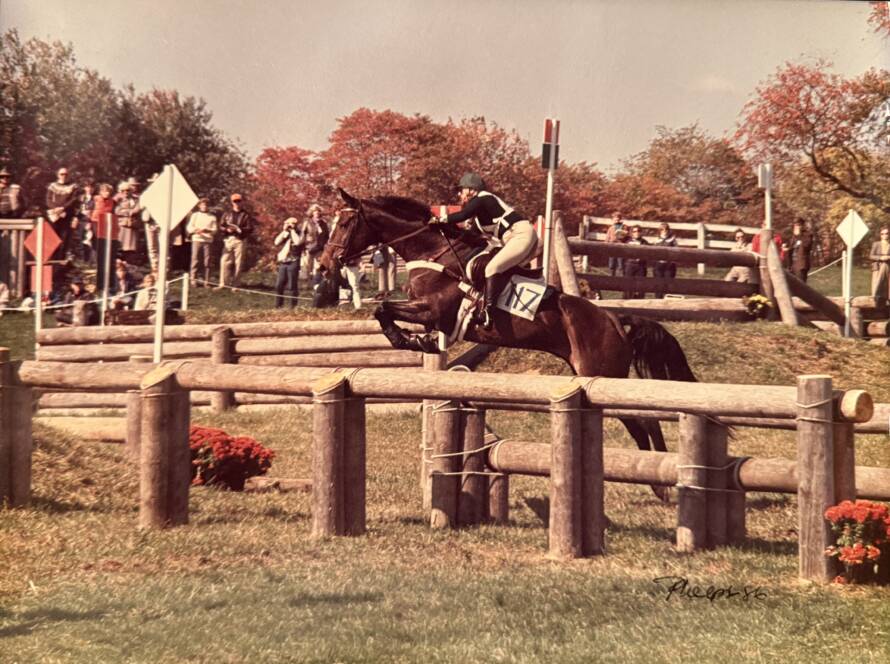
He has world explorers in his blood, but not equestrians. Nonetheless, he found his way to horses and Pony Club, becoming the first Bermudian rider to compete internationally when he rode in the alternate 1980 Olympic Games. He represented Bermuda again in 1984 and 1988 Olympics.
Peter became a Canadian citizen in 1995, coaching the country’s eventing team for the 1996 and 2000 Summer Olympics and serving as an alternate for Canada’s Olympic eventing team in 2004. More recently, he’s concentrated his riding on dressage, splitting his time between the Toronto area and Ocala, Florida, where coaching and clinic assignments keep him busy.
He’s proud and grateful to keep up his own riding, focused on one horse, Fergie, who is currently confirmed at 4th level dressage. “It keeps me humble as a judge,” he notes.
Peter still has family in Bermuda and plans to return over the holidays — though it won’t be entirely restful. “They’ve already got me judging a horse show and giving a clinic,” he says with a laugh. That relatively quiet time of year is when he plots his schedule for the next twelve months, aiming to give equal priority to judging, educating, and his own riding, which usually includes six competitions a year. “I really love all three.”
Galway Downs is grateful to have a place on Peter’s calendar.
Feature Photo: Peter and Fergie, by Susan Stickle Photography