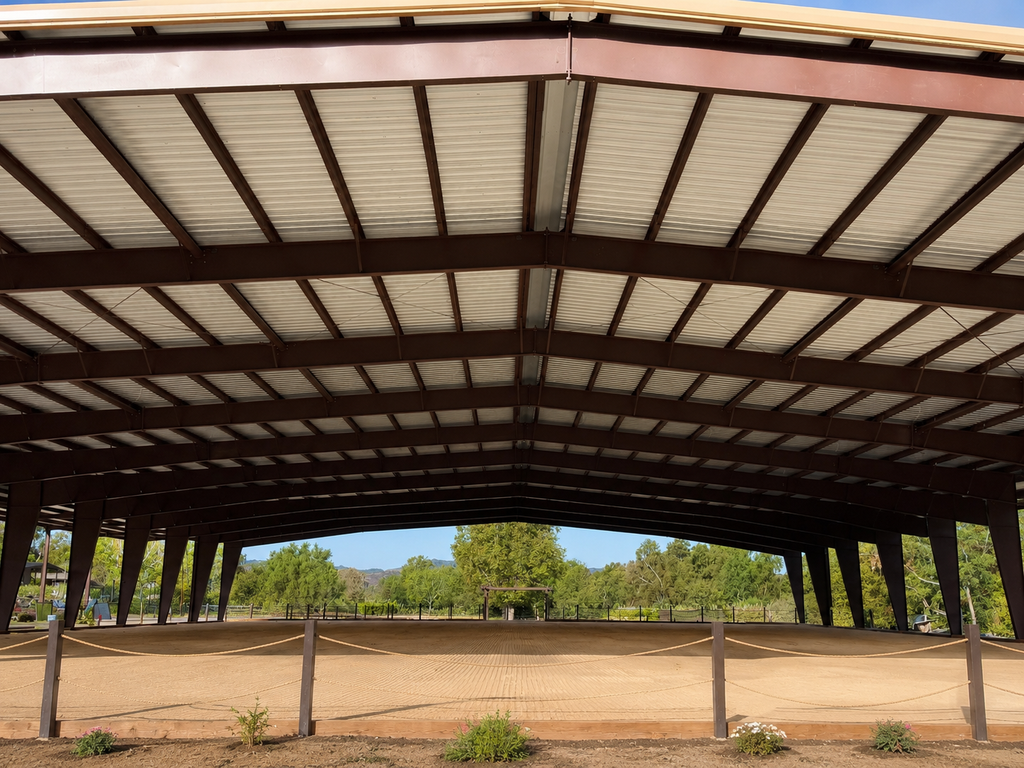
Conversations about a covered arena began not long after Ken and Tina Smith bought Galway Downs in 2010. For equestrians, the chance to ride sheltered from sun and rain has obvious appeal. And the addition felt like a natural next step in Galway’s evolution into a world-class equestrian and special-event venue.
A covered space with an adaptable riding surface opens the door to events and competitions well beyond the hunter/jumper, eventing and dressage disciplines for which Galway Downs has earned an international reputation.
For years, though, cost and logistics seemed to outweigh the benefits.
A Parking Lot Epiphany
Then Ken had an epiphany. “It might have been feasible earlier, but I wasn’t seeing it until I looked at the structures over high school parking lots that have solar panels on them,” he says. “I realized we might be able to get some additional use out of solar panels, rather than having them take up so much ground space on our property.”
The idea quickly gained momentum. Additional incentives for solar construction made the project even more attractive, as did the significant reduction in Galway’s environmental impact that comes from generating its own power.
Construction began last fall on a 44,250-square-foot clear-span cover over the space competitors know as the former warm-up ring for the Grand Prix Arena. The riding area itself will measure 177′ x 250′, with an adjacent hospitality area.
Beyond providing all-weather shelter for riding and other activities, the cover’s solar panels will generate an estimated 747,539 kilowatt hours of energy annually — enough to supply 100% of the 240-acre property’s power needs, based on past usage. “That turns our property into a dream in and of itself, from the standpoint of all the energy we use,” Ken says. “And there are big benefits to going greener and being more environmentally friendly.”
“The solar aspect is what drove the size of the covered space, and how it made financial sense to do it,” Ken continues. The roof’s apex is off-center, creating a larger south-facing surface where the panels are installed.
Future Focused
The project is rooted in Galway’s origin story. The Smiths bought the property from the brink of bankruptcy and likely residential development. Previous owners had tried and failed to make it work financially as an equestrian-only facility, an all-too-common outcome that’s led to the disappearance of California horse facilities over recent decades.
“It’s still a gamble,” Ken says of the undertaking’s scale and cost — and the time it’s taken. From conception to an anticipated “house warming or arena warming” party in late August or early September, the project will have taken about a year.
An Expanding Hoofprint
A handful of other Southern California competition venues have covered arenas, including Del Mar Horsepark, Rancho Mission Viejo Riding Park in San Juan Capistrano, and the Los Angeles Equestrian Center in Burbank. All were built in the 1980s and ’90s, before development radically reshaped the region’s equestrian landscape.
In creating one of the biggest clear-span arenas in the West, Galway’s investment signals optimism about the future of equestrian sports in Southern California — and the region’s top riders are taking notice.
“It could be hugely advantageous,” says Rebecca Rigdon, an international dressage competitor based in San Diego. “I’m really hoping it helps with a push to bring international dressage competitions – CDIs — back to Galway Downs, and with that, more riders down from Canada and the Northwest, where they don’t have great weather in the winter. A covered arena at such a super show facility is huge for our area.”
Rebecca has taken horses to compete in Europe for years and she’s especially drawn to the arena’s potential to simulate an indoor European show experience. “We’re trying to make future international horses, and this will really set them up well,” she says. While Galway’s arena isn’t fully enclosed like its European counterparts, she expects its design to create a quieter, more contained space where horses — especially young ones — can focus.
Galway Downs equestrian manager Robert Kellerhouse sees the addition opening doors in other ways too. “Some equestrian event producers won’t even consider a venue if it doesn’t have a covered arena,” he says.
Beyond weather protection, he expects the space to host special classes across disciplines — and to serve as a schooling space for boarders and visiting riders alike. “It opens up a whole new world,” he says.